Friday, November 24, 2006

Journalism Loses A Great Journalist


Former managing editor of The New York Times, Gerald Boyd, has died. He was 56.

Though few newspaper readers may know the name of their publication's managing editor, most NYT readers will sadly recall Boyd for being tangled in the scandal surrounding disgraced reporter Jayson Blair, who was exposed as a fabricator. Although that unfortunate circumstance has become "the comma" after Boyd's name, it is not a fair representation of his career.

A nice summary paragraph appeared in an Associated Press story. (Excerpt via Huffington Post):
The initial New York Times article stated that Boyd was "the first African-American to serve in many of the jobs he held at The Times, including metropolitan editor and managing editor," as well as winning a Nieman fellowship at age 28. Boyd joined the Times in 1983 and oversaw the 2000 Pulitzer Prize-winning series, "How Race is Lived in America." He took office on September 5, 2001 with former executive editor Howell Raines and together they led the paper through the terrorist attacks of September 11th, winning a Pulitzer Prize for its coverage.
A quote from The New York Times executive editor Bill Keller appeared in an updated obituary by The Associated Press:
''He knew how to mobilize a reporting team and surround a story so that nothing important was missed. He knew how to motivate and inspire,'' executive editor Bill Keller said, according to The Times. ''And, tough and demanding as he could be, he had a huge heart. He left the paper under sad circumstances, but despite all of that he left behind a great reservoir of respect and affection.''
One of the stories in The New York Times quotes a lecture Boyd gave a few years ago in St. Louis:
“Throughout my life I have enjoyed both the blessing and the burden of being the first black this and the first black that, and like many minorities and women who succeed, I’ve often felt alone.”
— TJ Sullivan in LA

Tuesday, November 21, 2006

Tripping Back To Old Bakersfield


Hat tip to my friend at Amy's New York Notebook for pointing out the interactive map of Old Bakersfield created by The Bakersfield Californian. Although some may argue that Bakersfield is hardly a part of Los Angeles, the histories of both places are linked just as surely as are their futures, and so I don't think it's too much of a stretch to make note of it here.

Like a lot of Los Angelenoes, I can't say I know much about Bakersfield. My intial, knee-jerk reaction, I must admit, was to write it off as another dusty town that became the butt of bad jokes. But, thanks to some good friends who've lived and worked there in the past, as well as a few news assignments that forced me to spend several nights there, my familiarity with Bakersfield has improved. And, I have to say, the more I learn about the place, the more I find something to like.

Thanks to this map, I've learned a great deal more. How else would I have become aware, for instance, that in the 1950s a bar in the Padre Hotel featured a girl on a swing and a girl in a tub on stage?

It's worth the time to check out the map, if only to get some ideas.

— TJ Sullivan in LA

Monday, November 20, 2006

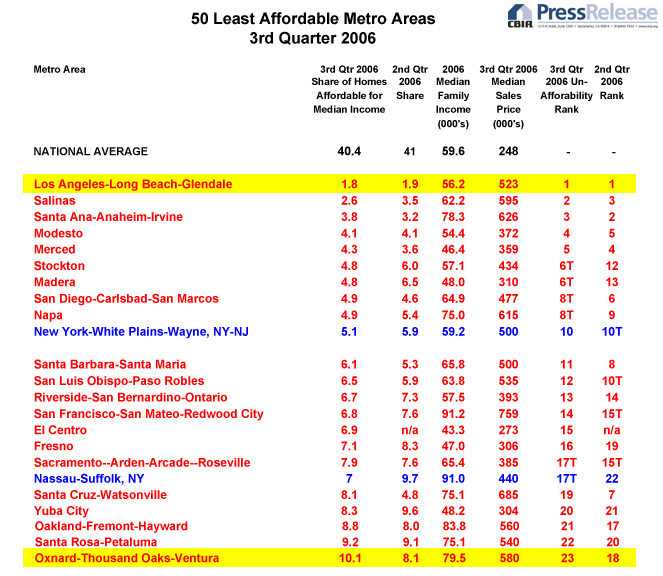
LA's Housing Crisis: 1.8% Affordability


Call it a housing bubble. Call it a balloon. Call it nothing of the sort. But whatever you do, the California Building Industry Association wants you to realize that a housing crisis has gripped The Golden State, particularly the Greater Los Angeles Area.

How bad is it?

According to the numbers released today by CBIA, only 1.8 percent of the homes in the Los Angeles-Long Beach-Glendale region are affordable for households making the median income of $56,200 a year.

In contrast, 10 percent of homes in Ventura County are affordable to median-income earners.

But far more startling than that is the national average of 40.4 percent!

That makes the Los Angeles housing market the least affordable in the entire U.S.A.

Robert Rivinius, CBIA President and CEO, said this today in today's news release:
“Despite all of the doom and gloom about housing prices dropping, affordability has improved only slightly and only in some parts of the state, and this does nothing to negate the fact that in the entire nation, the nine least affordable places to buy a home are here in California, as are 18 of the bottom 20.” Rivinius said. “When will our legislators and our local policy makers finally realize just how serious our housing affordability crisis is, and start taking steps to restore the American dream to more California families?”
The state isn't in much better shape than Los Angeles. CBIA says homeownership is 57 percent, which is 13 points less than the national average.

This is the eighth consecutive quarter that LA County has achieved the lowest affordability rank in the nation.

Even Orange County is better at 3.8 percent affordability for median income earners.

It's easy to beat this topic like a drum considering all the statistics available.

Some of the statistics, however, are changing.

The California Association of Realtors recently came up with some new math to calculate its affordability index. After 22 years CAR decided the old formula no longer offered a fair representation of the market.

CAR, whose national affiliate recently purchased advertisements boasting of a healthy housing market, has yet to release its affordability numbers for the third quarter of '06, but they should be coming soon, so keep watching CAR's list of news releases, or check back here.

— TJ Sullivan in LA

Training tomorrow's reporters... in LA


My latest blog entry at Native Intelligence concerns my experiences in trying to connect the students in my journalism class with the Los Angeles Police Department.

Native Intelligence is a feature of LA Observed

— TJ Sullivan in LA

Saturday, November 18, 2006

As Your Attorney I Advise You To Buy This Book...

A new book (with words even) by illustrator Ralph Steadman is reviewed in The New York TImes:
The illustrator Ralph Steadman is a brave man. Not only did he survive humiliation, gunplay and hallucinatory despair through decades of collaboration with the legendarily difficult journalist Hunter S. Thompson, he decided to include as the epigraph to his memoir of those adventures a remark of Thompson’s: “Don’t write, Ralph. You’ll bring shame on your family.”

To follow this with a 400-page ramble is the sort of dare the prank-loving Thompson, who committed suicide last year, might have appreciated. For the sake of the Steadman family’s honor, it should be said that “The Joke’s Over” features a lot of Steadman’s drawings, though reduced too much from their original size. True, these pictures don’t exactly constitute writing, but they are brilliant. Splattery explosions of ink, detonated in the presence of politicians and stolid middle-class citizens, they stand as the mangling visions of a 20th-century Hogarth. When they originally appeared (usually in Rolling Stone), lodged amid Thompson’s prose, the images served as the visual equivalent of the writer’s “gonzo” — a term Steadman defines as “controlled madness” — explorations of America.

— TJ Sullivan in LA

Friday, November 17, 2006

Game Over


This time the masses that encircled the big box at the corner of Pico and Sawtelle boulevards didn't come bearing flowers and Sharpies hoping to meet Paris Hilton, or Dave Navarro. This was a far more serious affair. This was about money, and lots of it.

A new blog entry at Native Intelligence

— TJ Sullivan in LA